Monday, 28 January 2013

Last Nights Full Moon

Last Nights Full Moon is often referred to as the "Full Wolf Moon" as it was in the sky when wolves could be heard calling in the snow. Some call it the Old Full Moon.
For me the full moon always looks stunning as it hangs majestically in the sky. However its the worst time to image it. Flat and disappointing when the images are downloaded. It lacks detail because the sunlight is not casting any shadows. I've tried HDR but it looks unreal so processing this image is quite simple. Mainly contrast improvements using curves with an additional layer, its blending mode set to soft light and 20% opacity. It seem to be the best I can do without a lunar filter.

Tuesday, 15 January 2013

Today's Sun Spots.

A rare sight in southern England. 
THE SUN
 
I took this image of the Sun with my little 70mm skywatcher refractor which has a focal length of 500m mm. The camera was a Canon 400d shooting through the scope like a long telephoto lens.
Its nice an quick to set up using just a simple tripod. The filter was diy using Baader AstroSolar safety film.
PLEASE, PLEASE DON'T LOOK AT OR POINT ANY CAMERA AT THE SUN WITHOUT USING  PROPER SOLAR FILTERS OR YOU WILL SEVERELY DAMAGE YOUR EYES IN AN INSTANT.

Monday, 7 January 2013

Over saturated Moon


This picture was taken with a Canon 40D through my Etx 105 at prime focus .
Normally a colour image of the moon is grey with some slightly blueish areas. During post processing I often change elements like contrast  to bring out the shadows but I recently learnt from Filipe Alves that by increasing the saturation of the colours in the image, details about the Moons geology composition can be revealed.
I have not added any colours to this image, merely magnified the colours in the image.
It is often called a false colour image as this is not how its seen with the naked eye.
In 1992 NASA's spacecraft Galileo produced an image using filters that is remarkably similar. The blue colour shows titanium rich areas whilst the orange areas are lower in titanium. The Sea of Tranquillity where Neil Armstrong and Buzz Aldrin landed in Apollo 11 in 1969 is to the right of centre and shows up really blue so its high in titanium.
Anyway all that aside, I think its good to see the moon is not just grey but a marvolous mix of colour.

Tuesday, 11 December 2012

M42 Orion Nebula

About 1,344 Light Years away, this beautiful Nebula can bee seen with the naked eye as a fuzzy blob.
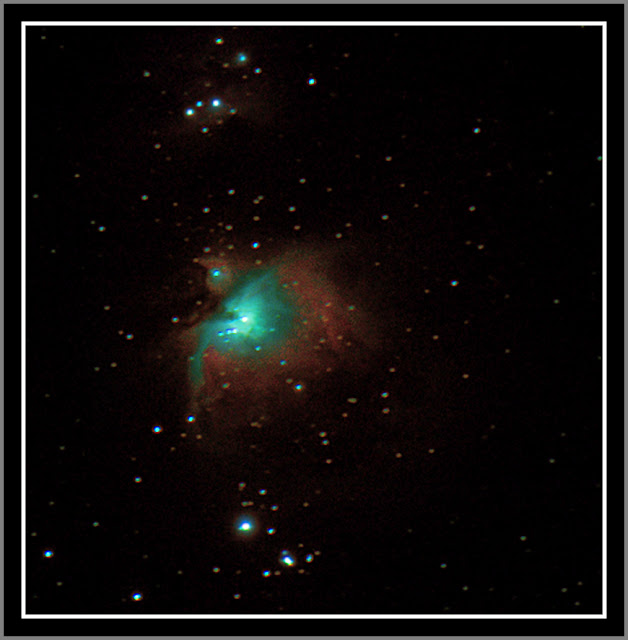
Situated just below Orion's belt, it forms the central part of what is often known as the sword of Orion and its the closest massive place where stars are being born.
Its still a long long way away though as a light travels at 186,000 miles ever second so just multiply
by 31,557,600 seconds in a year by 1,344 years.
I'm pleased with this image as it was unguided and I could sit in my house (in the warm) and watch the images on my laptop coming from the camera outside in the freezing cold. I just popped out and moved the tripod every 20 shots.

Technical details are;
Canon 40D unmodified with 200mm lens @F/4 controlled by APT on a Manfrotto tripod .
The Raw images were stacked using 197 Lights, 30 Darks shot at 2 sec @1600iso and 20 bias @1/8000 sec. Mirror lockup and 5sec delay and 15 seconds between frames to allow the sensor to cool down.
Stacked in DSS and adjusted in PS.
I know these astro images are light years from the quality of most astro photographers but for me I learn so much more about astronomy by taking them.
So often I just looked through my telescope in awe but didn't really understand what I was looking at. Now I enjoy checking out what I have captured during those long cloudy nights.

Sunday, 9 December 2012

Jupiters Great Red Spot

Finally I managed A reasonable image of Jupiter's Great Red Spot.
1200 images were stacked to reveal this giant storm which has been raging for at least 400 years. Two Earth's could fit inside the red spot, but with 270 mph winds its a violent place to be. A day on Jupiter lasts only 9 hours and 55 minutes so to get a picture of the spot I had to plan the time using the web. I live in a large town so light pollution can a problem until the early hours when the sky is darker.


Sunday, 2 December 2012

M31 Andromeda and M110 untracked

This image was taken not with my telescope but with a Digital slr and a 200mm lens mounted on a tripod.
 Its made up of 347 light frames, 31 dark frames and 23 Bias frames.
Without going into too much detail, the dark and bias frames are taken with the camera lens cap on and are used to eliminate camera sensor noise and hot pixels.
With a shutter speed of 3.2 seconds @F4 it took some time as I used a remote release cable. Next time I will control the camera from inside the house with the hear on.
I processed the frames using Deep Sky Stacker( another free program) which took about 6 hours before adjusting noise and levels.
 
I was really pleased to see M110 (Andromeda's dwarf spheroidal satellite galaxy) for the first time as I cant see it with my eye through the telescope. You can see M110 below and to the right of Andromeda.
Checking the image against Stellarium I noticed M32 (a Dwarf Elliptical galaxy containing a supermassive black hole with a mass as big as 5 million Suns) another of Anromeda's satalite galaxies.
The image also shows the dust lanes which look like gaps in Andromeda's spiral arms.

Monday, 19 November 2012

Jupiter

My second attempt at capturing Jupiter ( the gas giant) with a webcam. This time I used a free software program called Castrator which does a great job of aligning the 2000 images. The next step uses another free program called registax which stacks and enhances the image.
Astrophotography is a lot more difficult than I thought. Its very time consuming aligning the telescope and camera in the dark and cold at 2am. I'm pushing my Meade telescope to its limits and much of the equipment I have is homemade, so to produce images like this which show alot more detail than can be seen by looking through the scope makes it all well worth it.
 

Friday, 5 October 2012

Polaroid pictures

If you have photoshop, here is a neat and quick way of adding a twist to your favourite pictures.
A big thank you to Gavin Hoey for this free template which just takes a few clicks to use.
Gavin is an amazing photographer and teacher.
You can visit his website  at www.gavtrain.com

Friday, 28 September 2012

Jupiter with a webcam

This image was taken using my Meade Etx105PE scope fitted with a modified Microsoft lifecam.
Using Registax I combined 2000 images to reveal much more detail than you could see with the naked eye.
Four of Jupiter's 50 moons can be seen in the image as they orbit this giant planet some 400 million miles away.
From left to right they are, Europa,Callisto,Ganymede and Io.
The moons are very different and make intersting reading.
Hopefully Juno, sent to Jupiter on a oneway trip will uncover more of its secrets.
 

Wednesday, 5 September 2012

2012 Bournemouth Airshow Red Arrows

Another excellent display from the Red Arrows this year. They flew so close  that I could see how the colour is injected into the exhaust to produce the amazing coloured smoke.
I'm using this image as my laptop wallpaper.
Shooting in raw format helps as I can adjust things like exposure if its not exact when I get home.
I over exposed by 1 & 1/2 stops as the sky is always bright and it reduces the chances of getting just a silhouette. I chose ISO 100  and f9 but kept the shutter speed up as high as possible to freeze the high speed. 1/400 sec was fine as I also panned the camera as it passed by.